

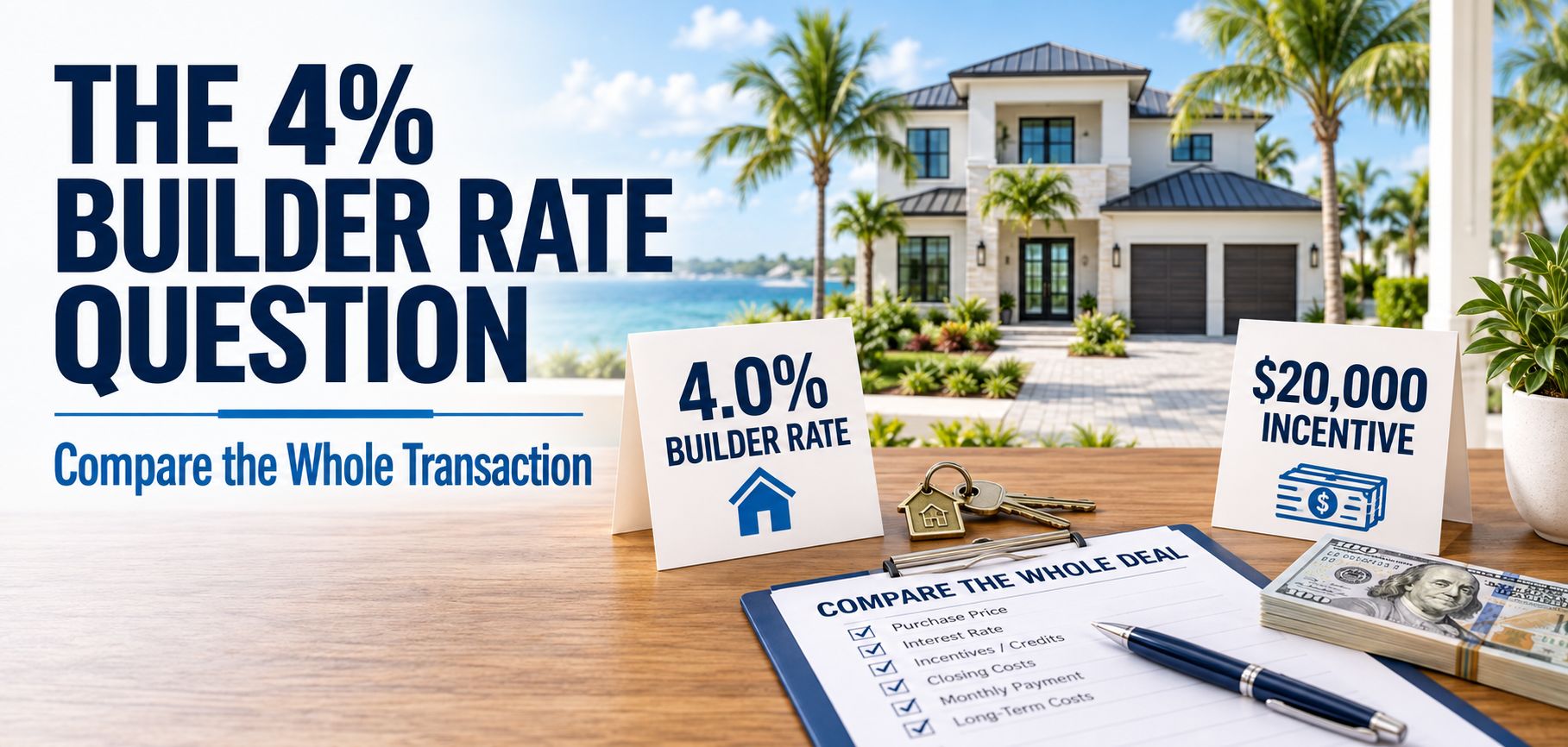
If you have been shopping for a newly built home lately, you may have seen advertisements that look almost too good to be true:
Mortgage rates in the 4% range.
At a time when typical market mortgage rates are considerably higher, that kind of offer can stop a buyer in their tracks.
And to be clear, some of these builder incentives can be excellent opportunities.
But before you choose a home or a lender based solely on the advertised interest rate, there is a much more important question to ask:
Where is the money coming from to create that lower rate?
Because the rate may be discounted, but it is not free.
Builders Are Competing on Monthly Payment
According to a recent Realtor.com analysis, 13.8% of new-construction listings advertised a reduced mortgage rate in August 2026, with the average advertised rate coming in at approximately 3.92%. At the same time, the typical 30-year fixed mortgage rate cited in the analysis was about 6.67%.
That difference can create substantial monthly savings for a buyer.
Realtor.com calculated that on a median-priced $450,000 new home with 20% down, the difference could amount to roughly $614 per month in principal and interest.
That is meaningful.
It also explains why builders are leaning so heavily into financing incentives.
Instead of competing only on the sales price of the home, builders can compete on the number buyers often care about most:
The monthly payment.
Somebody Is Paying for That Rate
A mortgage rate does not simply drop several percentage points because a builder has a relationship with a lender.
There is a cost associated with creating that lower rate.
And builders are spending significant amounts of money on incentives.
Realtor.com reported that Lennar's incentives averaged approximately $62,700 per home in fiscal 2025, representing 13.8% of home-sale revenue. PulteGroup reported incentives equal to 10.9% of gross sales price during the first quarter of 2026. Those figures can include financing incentives as well as other discounts and concessions.
Why would a builder spend that much instead of simply lowering the price?
Because lowering the mortgage rate can sometimes produce a much larger improvement in the buyer's monthly payment than the same amount of money applied as a price reduction.
The Realtor.com analysis cites research estimating that reducing a mortgage rate by one percentage point could cost a builder approximately 3.2% of the home's price, while creating a similar monthly-payment reduction through a price cut could require approximately a 10% reduction in the home's price.
For the builder, that math can make perfect sense.
For the buyer, however, it means the lowest advertised rate does not necessarily tell you which transaction offers the best overall value.
Don't Compare Rates. Compare Transactions.
Imagine you are comparing two homes.
One builder offers an extremely attractive mortgage rate through its preferred lender.
Another property may have a higher mortgage rate but a lower purchase price, more seller concessions, fewer fees, different closing costs, or greater negotiating flexibility.
Which one is the better deal?
You cannot answer that by looking at the interest rate alone.
You need to compare the complete transaction.
That means looking at things such as:
- Purchase price
- Mortgage rate
- Whether the rate is permanent or temporary
- Closing costs
- Discount points or financing charges
- Builder or seller concessions
- Property taxes and insurance
- HOA or CDD expenses
- Cash required at closing
- Monthly payment
- Comparable property values
- How long you expect to own the home
The best financing decision is rarely determined by one number.
Is the Rate Permanent or Temporary?
This is another important distinction.
Not every advertised low rate works the same way.
Some builder programs use a permanent interest-rate buydown. Others may use a temporary subsidy that reduces the buyer's payment during the first one, two, or three years.
For example, Freddie Mac guidelines allow certain temporary subsidy buydowns where the initial rate or payment can be reduced and then increase annually until reaching the full note rate.
There is nothing inherently wrong with a temporary buydown.
It can be a useful financial tool.
But buyers should understand exactly what happens after the introductory period ends.
If you are qualifying or budgeting based on the temporary payment rather than the eventual payment, you need to know that before closing, not when the payment changes later.
What About the Value of the Home?
This is where the conversation becomes even more interesting.
If builders can make a higher-priced home affordable by subsidizing the mortgage rate, they may not need to reduce the actual price of the home as aggressively.
Realtor.com's analysis found that new-construction listing prices were down approximately 0.3% year over year in August, compared with a 2.5% decline for resale homes. The data does not prove that builder incentives caused that difference, and results varied significantly by market, but it raises an important question about how incentives can influence pricing.
Freddie Mac has also instructed appraisers to carefully consider financing and sales concessions when analyzing comparable sales.
Its appraisal guidance specifically notes that builder concessions and mortgage-rate buydowns may be used in new subdivisions to generate buyer interest and support higher sales prices.
Again, this does not mean a builder's home is overpriced simply because an incentive is being offered.
It means buyers should understand both sides of the transaction:
What am I paying for the house, and what am I receiving through the financing?
The Resale Question Matters Too
There is another issue buyers sometimes overlook.
Suppose you purchase a new home today and receive an attractive builder-subsidized mortgage rate.
A few years from now, you decide to sell.
You may then be competing against the same builder, except the builder could still be offering financing incentives to buyers of brand-new homes.
You probably will not be able to offer the next buyer the same subsidized financing package.
That does not make buying new construction a bad decision.
It simply means your decision should make sense beyond the initial monthly payment.
Builder Incentives Can Be Fantastic
I want to emphasize this because the goal is not to scare anyone away from new construction.
There are situations where builder financing incentives are extremely valuable.
If a builder is willing to spend tens of thousands of dollars to lower your interest rate, reduce your closing costs, or improve your monthly payment, that can be a tremendous opportunity.
The mistake is assuming that the advertised rate automatically makes it the best deal.
Sometimes it will be.
Sometimes a different combination of price, concessions and financing will make more sense.
And sometimes the builder's offer absolutely crushes every alternative.
You will not know until you compare the numbers.
Before You Sign With the Builder's Lender
Before committing to a builder's preferred financing option, have someone review the entire transaction with you.
Not simply the interest rate.
Not simply the payment.
The entire deal.
Ask:
What is this incentive actually worth?
Could the money be structured differently?
Is the advertised rate permanent?
What does the home look like compared with nearby resale properties?
What happens if I refinance or sell earlier than expected?
How does this offer compare with financing available outside the builder?
A good mortgage strategy is not about chasing the lowest rate printed on an advertisement.
It is about understanding how all the pieces fit together so you can make the decision that works best for your finances, your family and your long-term goals.
That 4% mortgage rate may be an incredible deal.
Just make sure you understand the price of getting it.
Kevin Corbett
NMLS 19116
Mortgage Loan Originator
Gulfside Mortgage Services
941-899-3019
Equal Housing Lender
This information is for educational purposes only. Mortgage programs, rates, costs, incentives and qualification requirements vary and are subject to change. Individual circumstances should be reviewed before making a financing decision.
Share


RECENT ARTICLES
Free Guides & Resources
Our favorite kind of buyer? A confident one. Brush up on your loan knowledge, get an accurate quote, and let's get to it.



What Our Customers Say