

Florida has always attracted people who eventually want to make it home.
Maybe you're living and working in New York, New Jersey, Massachusetts, Michigan, or somewhere else up north today. You know Florida is where you ultimately want to be, but retirement is still a few years away.
So why not buy the Florida home now?
That can absolutely be a great strategy.
But there's an important mortgage question that needs to be answered before we start talking about loan options, down payments, or interest rates:
How are you actually going to occupy the property?
"I'm Buying It to Live There Eventually"
I recently spoke with someone in almost exactly this situation.
She currently lives and works in New York but wants to purchase a home here in Florida. She plans to enjoy the property when she's able to travel south, maintain her living arrangements in New York with her partner, and then eventually retire and make Florida her full-time home.
She had already spoken with other mortgage professionals and had been discussing financing for the Florida property as a primary residence.
But when we started talking, I asked a few more questions.
Can you work remotely?
Yes — partially.
Can you work remotely from Florida full-time?
No.
Her employer requires her to physically report to work in New York.
And that's where the conversation changes.
Your Future Intention Isn't Necessarily Your Current Occupancy
When you're applying for a mortgage, occupancy is based on how you legitimately intend to use the property after purchasing it.
Planning to retire to Florida two or three years from now doesn't necessarily make the Florida property your primary residence today.
If your job requires you to regularly report to an office in New York while you're purchasing a home hundreds or thousands of miles away in Florida, that's something we need to address.
An underwriter may reasonably ask:
How is the borrower going to occupy this Florida property as their primary residence while maintaining employment that requires their physical presence in another state?
That's a very different situation from someone whose employer has authorized them to work remotely from Florida.
And that's why these conversations matter.
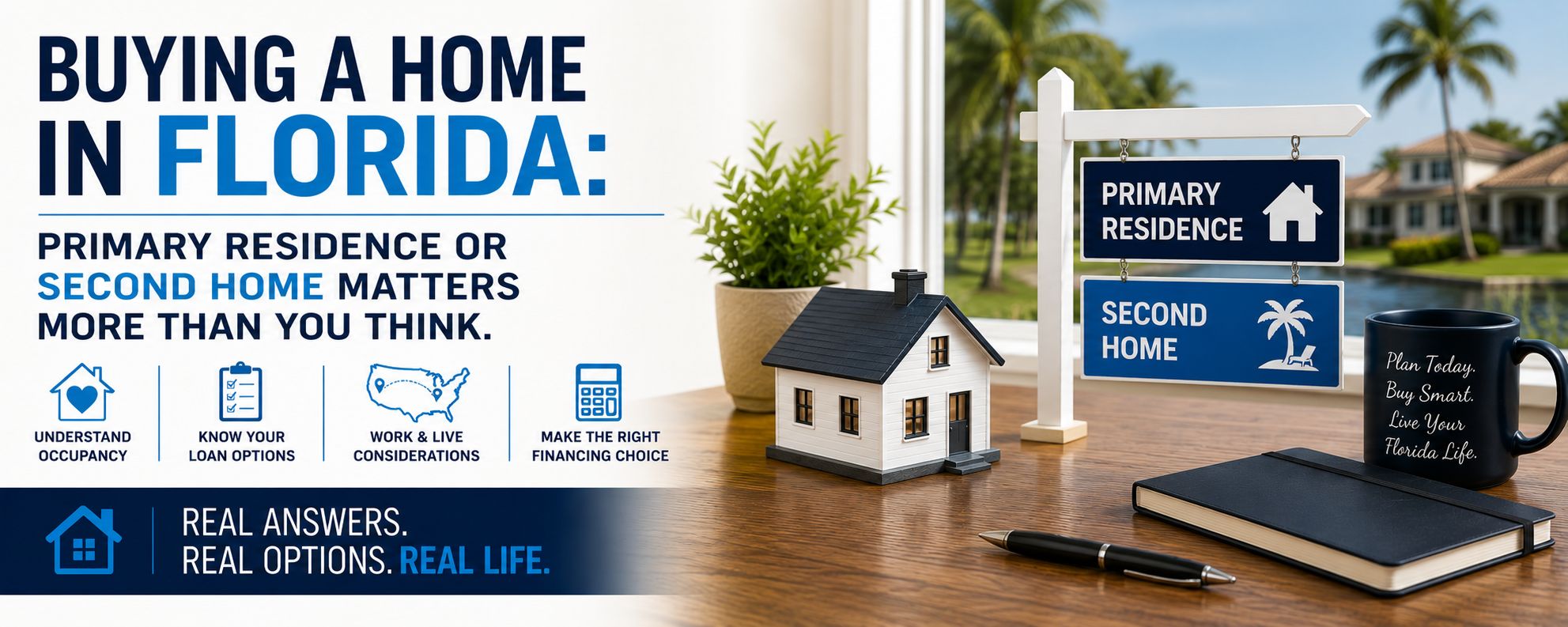
Primary Residence vs. Second Home
A primary residence is generally the home you intend to occupy as your principal residence.
A second home is different. It may be a property you use seasonally, for vacations, or during portions of the year while maintaining your primary residence elsewhere.
And yes, that distinction can affect your financing.
Depending on the loan program and individual circumstances, occupancy can potentially affect things like:
- Available loan programs
- Down-payment requirements
- Interest-rate pricing
- Underwriting requirements
- Documentation
- Insurance considerations
That's why I don't want to assume how you're going to occupy a property simply because you tell me you're "moving to Florida."
I want to understand what moving to Florida actually looks like for you.
Keeping a Home Up North Doesn't Automatically Mean You Can't Buy a Florida Primary Residence
This is where these situations become very fact-specific.
Owning another home doesn't automatically prevent you from purchasing a new primary residence in Florida.
Maybe you're selling it.
Maybe you're converting it to a second home or investment property.
Maybe your spouse is relocating first.
Maybe you're fully remote and your employer has documented that you can permanently perform your job from Florida.
Maybe you're self-employed and your business can legitimately operate from Florida.
There are plenty of situations where purchasing a Florida home as a primary residence can make sense.
The important part is that the facts need to support the occupancy.
The Snowbird Question
We see another version of this all the time in Southwest Florida.
Someone wants to buy a Florida home now, spend winters here, return north during other portions of the year, and eventually make Florida their permanent home.
That's a perfectly legitimate lifestyle.
But from a mortgage standpoint, we still need to determine what the Florida property actually represents today.
Primary residence?
Second home?
Investment property?
Those aren't interchangeable labels. They describe different intended uses of the property and can carry different financing requirements.
This Is Why the Mortgage Consultation Matters
Getting preapproved shouldn't simply be:
"Here's how much you qualify for, and here's today's payment."
A good mortgage consultation should uncover the story behind the purchase.
Where do you currently live?
Where do you work?
Are you required to report to an office?
Can you work remotely from Florida?
Are you keeping your current home?
How much time do you realistically expect to spend in Florida?
When do you plan to make Florida your permanent residence?
Those answers help determine how the loan should be structured before you make an offer.
Because the last thing I want to do is tell someone one thing at the beginning of the process only to have underwriting uncover information later that forces us to restructure the loan.
I'd rather ask the extra questions upfront.
Thinking About Buying in Florida Before You Retire?
You don't necessarily have to wait until retirement to purchase your Florida home.
There may be several ways to accomplish what you're trying to do.
But the right financing strategy starts with understanding how you'll actually use the property today, not simply how you hope to use it several years from now.
If you're considering buying a home in Florida while still living, working, or owning property in another state, let's talk through the entire situation first.
Sometimes the most important part of a mortgage consultation isn't giving you an answer.
It's knowing which questions to ask.
Share


RECENT ARTICLES
Free Guides & Resources
Our favorite kind of buyer? A confident one. Brush up on your loan knowledge, get an accurate quote, and let's get to it.



What Our Customers Say